
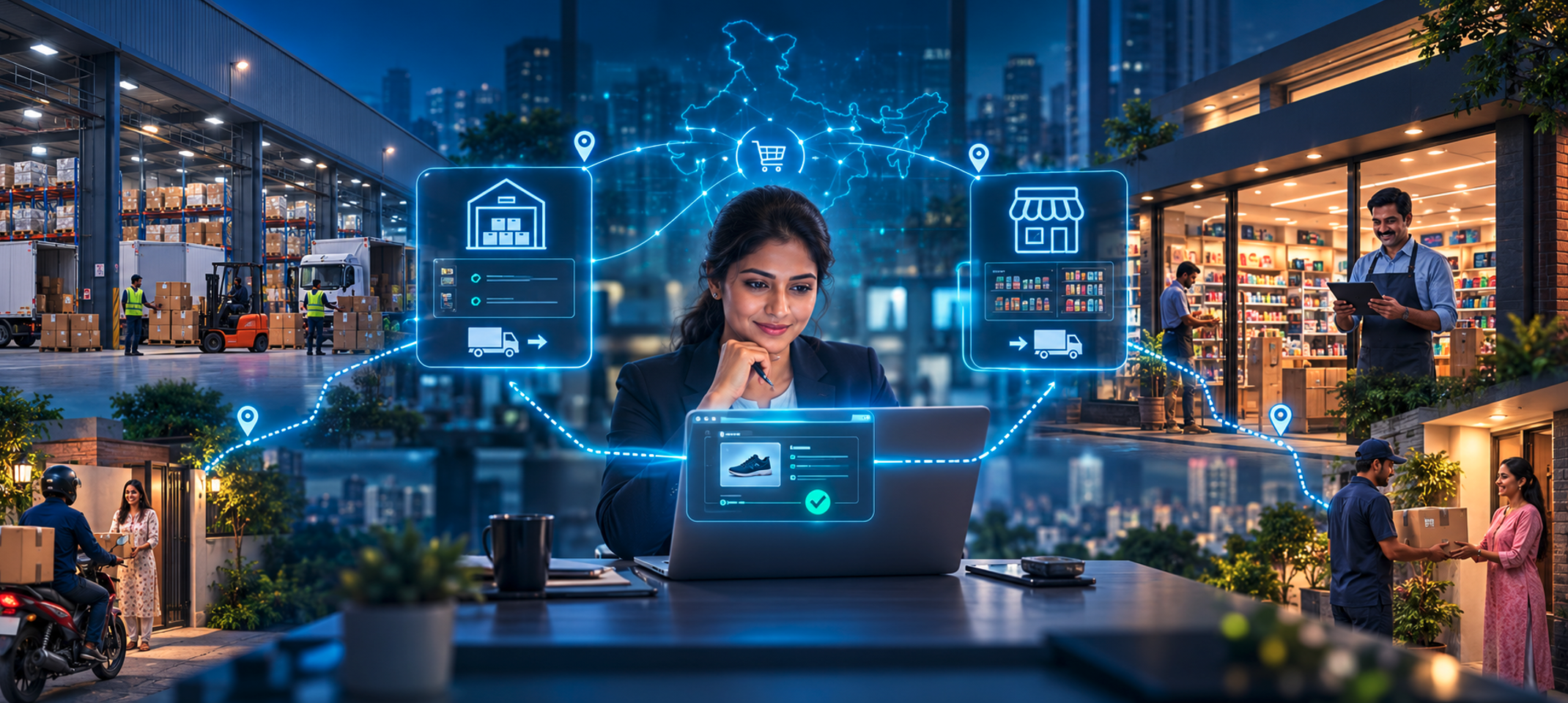
Phygital commerce means online demand fulfilled by the physical network a brand already owns: its warehouses and its dealers, rather than a separate ecommerce supply chain.
The term "phygital commerce" gets used loosely enough that it has started to mean almost nothing — a QR code on a shelf, an in-store tablet, a loyalty app. None of that is what we mean by it, and none of it is what actually moves revenue for the enterprise brands we work with.
The actual definition
Phygital commerce means routing online demand through the physical infrastructure a brand already owns — its warehouses, its dealer network, its service centres — instead of building a parallel, purely digital supply chain to serve it. The customer experience is digital: browsing, ordering, paying, tracking. The fulfilment is physical, and it runs through assets and relationships the brand has already spent years building.
This distinction matters because most D2C tooling defaults to the opposite model. Shopify, most headless commerce platforms, most quick-commerce integrations — they assume you are building fulfilment from scratch: a 3PL, a dedicated warehouse, a courier contract. For a digital-first brand with no existing physical network, that is often the right call. For an enterprise brand that already has 40 dealers and three regional warehouses, building a second, disconnected supply chain to serve online orders is not efficiency. It is duplication.
Why this is not the same as "omnichannel"
Omnichannel, as the term is usually used, means a consistent customer experience across channels — you can start a return online and finish it in a store, loyalty points work everywhere, and so on. It is a customer-experience idea.
Phygital commerce, as we use it, is a supply-chain idea. It is specifically about which infrastructure fulfils an order, not about how consistent the brand feels across touchpoints. A brand can have excellent omnichannel UX and still be running two entirely separate, uncoordinated fulfilment operations behind it — one for retail, one for D2C. That is the exact setup that creates channel conflict, inflates logistics cost, and gives the brand two different views of the same customer.
What it looks like in practice
A customer places an order on the brand's app. The order management layer checks which dealer or warehouse is closest and has stock. The order routes there automatically. The dealer accepts and dispatches — in our implementations, over WhatsApp, because that is the tool the field already uses without any new training. The brand's team sees one unified view of the order regardless of which physical node fulfilled it. The customer never knows or cares which warehouse it came from; they just get the product.
The commercial effect is what actually matters: the brand gets D2C-quality data and margin structure on the demand side, without having to build and finance a second supply chain, and without cutting the trade network out of revenue it has historically earned.
Why more brands haven't done this already
Mostly because the platforms available were built for one model or the other — either enterprise ERP/OMS systems that assume a single warehouse-led operation, or D2C storefront tooling that assumes no existing physical network at all. Building the routing logic that sits between them, and getting a distributed dealer network to actually adopt a new order-acceptance workflow, is an operating problem as much as a technology one. It is also, in our experience, the single highest-leverage thing an enterprise brand can fix before scaling D2C spend any further.
Common questions
No. Omnichannel is about a consistent customer experience across touchpoints. Phygital commerce is specifically about which physical infrastructure fulfils an online order.
Usually not. The whole point is routing demand through warehouses and dealers the brand already has, rather than building a second, parallel supply chain.
Enterprise brands with an existing distribution or dealer network. A digital-first brand with no physical footprint yet has less to route through.