
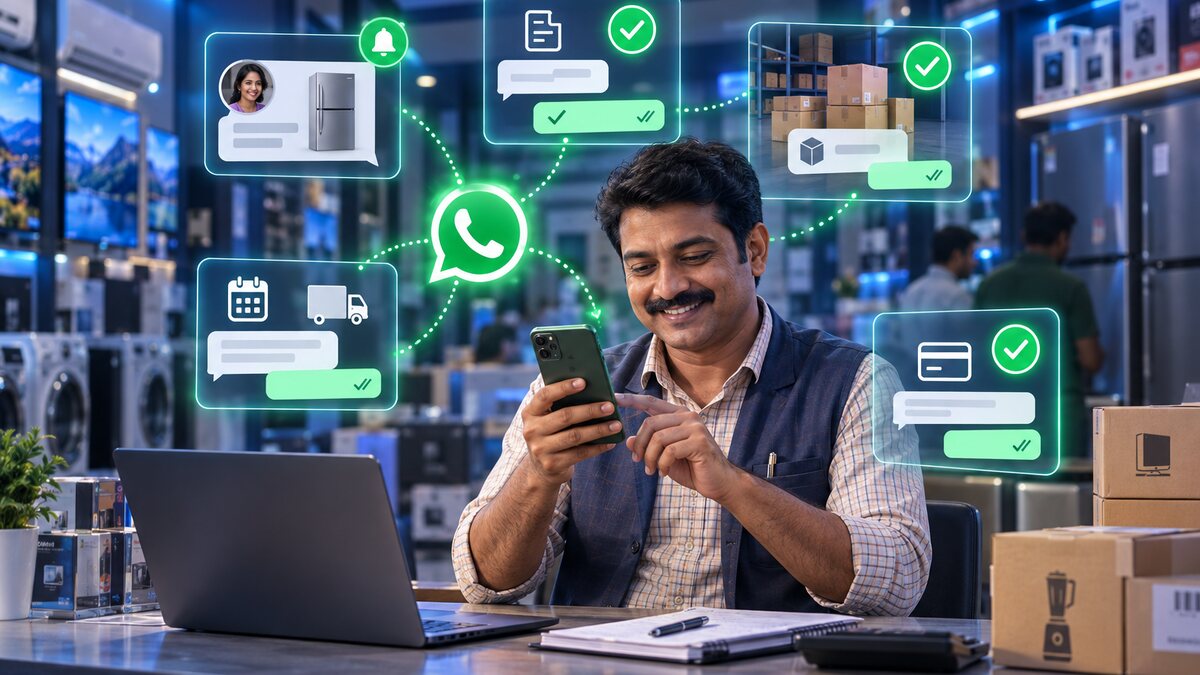
Dealers accept and dispatch orders through WhatsApp because it is the tool the field already uses. No new hardware, no app to install, no training programme.
We have brought more than a dozen dealer networks online, across categories as different as home security and Ayurvedic nutraceuticals. The most common failure point is never strategy. It is adoption — specifically, asking a dealer to learn a new piece of software to participate in a channel that, from where they are standing, looks like a threat to begin with.
Why the obvious solution doesn't work
The instinct, understandably, is to build a dealer portal: a login, a dashboard, order notifications, inventory sync. It looks professional in a deck. In the field, it fails for a boring reason — most dealers are running a small operation with limited staff, and a new app with a new password is one more thing standing between them and getting paid. Adoption rates for dedicated dealer portals we have seen elsewhere in the industry typically sit under 30% after the first quarter. The other 70% keep working the way they always have, and the online orders assigned to them either go unfulfilled or get manually chased by someone on the brand's ops team — which does not scale past a handful of dealers.
What actually gets adopted: the tool they already have open
Every dealer we have worked with already runs their business, at least partly, over WhatsApp — supplier orders, customer queries, staff coordination. So instead of asking them to adopt something new, the order comes to them there: a structured message with the customer's order details, delivery address and a simple accept/reject action. No app to download, no credentials to remember, no training session required.
This alone typically gets adoption above 90% within the first few weeks, because it removes the actual barrier — not unwillingness, but friction.
What has to sit behind that simple message
The WhatsApp message a dealer sees needs to look effortless. What makes that possible is an order management layer doing real work behind it:
- Automatic routing by pincode and current stock position, so the right dealer gets the order without anyone on the brand's team manually assigning it.
- A response-time rule — if a dealer does not accept within an agreed window, the order automatically reroutes to the next-nearest dealer, so a slow response never becomes a lost sale.
- Status sync back to the brand and the customer — accepted, dispatched, delivered — without requiring the dealer to do anything beyond replying to the WhatsApp thread.
- Basic reconciliation so the dealer's margin and the brand's reporting agree at the end of the month, without a spreadsheet exercise on either side.
The result, in numbers we have actually seen
Across the networks we run, dealer response times average under two hours once this is in place, versus routine multi-day delays when brands were manually phoning or emailing dealers to place online-originated orders. More importantly, the trade relationship survives the transition to D2C intact, because dealers experience the online channel as new orders arriving in a familiar place — not as a system change imposed on them from head office.
The lesson generalises past WhatsApp specifically: the fastest way to get a distributed, non-technical network to adopt a new process is to bring the process to a tool they have already mastered, rather than asking them to master a new one.
Common questions
Adoption. Dedicated portals for distributed, non-technical dealer networks typically see under 30% adoption after the first quarter, because a new login is one more barrier to a dealer just trying to get paid.
An automatic response-time rule reroutes the order to the next-nearest dealer, so a slow reply never becomes a lost sale.
That is the point of using WhatsApp — it requires no new skill, since it is the tool the field already uses daily for supplier and customer communication.