
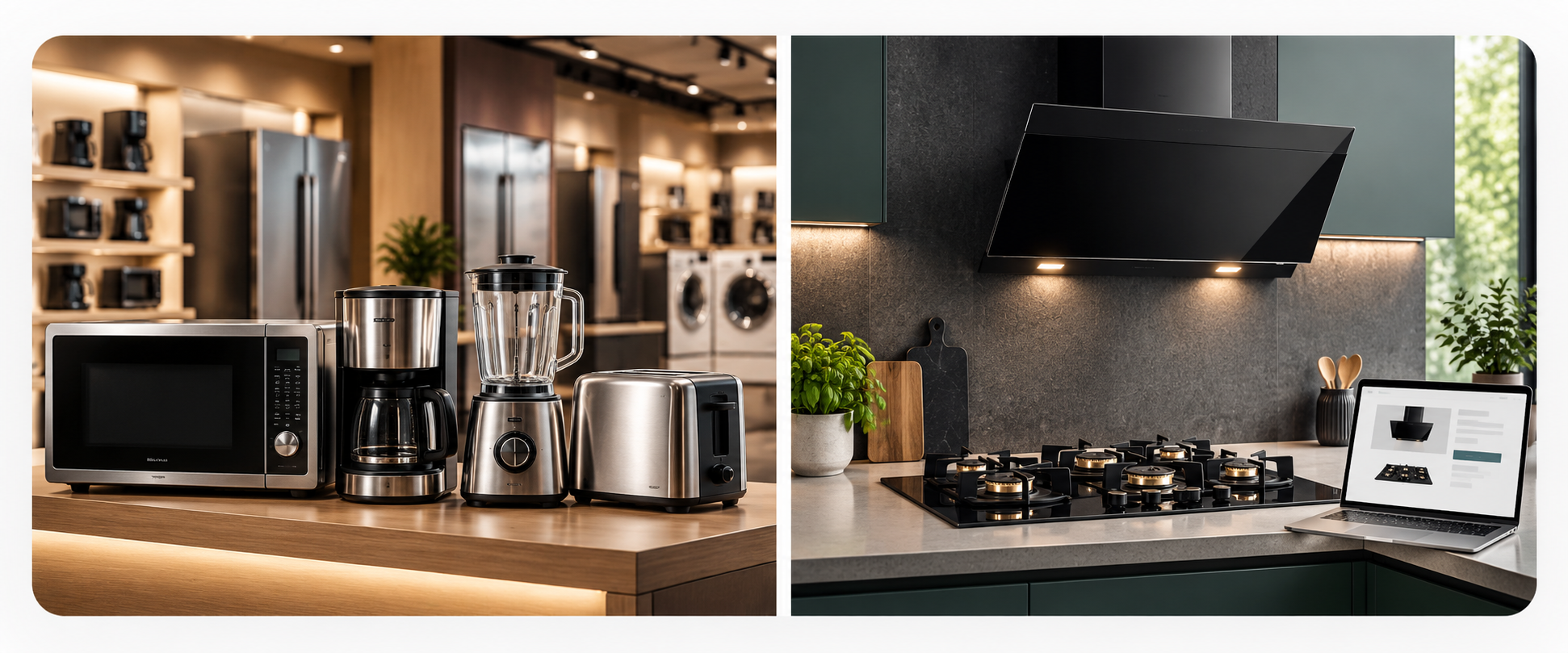
A century-old appliance brand with a strong dealer-led business wanted to enter the kitchen appliances category and specifically hobs and hoods - a highly competitive category dominated by specialist local heritage brands. Instead of first building a large dealer network and waiting for demand to follow, Brandbuddiez reversed the conventional approach. We created demand online, routed qualified customers and orders to local stores, and used demonstrated demand to expand the brand’s physical presence.
The business problem
The brand had strong recognition and an established dealer network in small appliances, but little presence or credibility in hobs and hoods. It needed to enter the new category without committing years to conventional dealer expansion or depending on heavy discounting to gain market share.
The situation
The brand had built a century of trust in the Indian appliance market through a largely dealer-led small and domestic appliances business. However, entering hobs and hoods meant competing in a very different category and building a whole new network as the channels The segment was controlled by specialist heritage brands with deep product expertise, established customer perceptions and long-standing relationships with kitchen retailers. Even several large appliance companies had struggled to establish a meaningful presence. The brand’s existing strength could open conversations with dealers, but it could not guarantee shelf space or sales. Retailers were hesitant to invest in displaying and stocking an unfamiliar range without evidence of customer demand. At the same time, hobs and hoods could not be treated as a purely online category. Design, finish, dimensions and installation influence the purchase, and many customers prefer to see and understand the product before deciding. The challenge was therefore to use digital commerce to enter the category while retaining the local dealer as an important part of the customer experience.
The approach
Brandbuddiez developed an online-first, phygital market-entry strategy. Rather than begin by building a large physical network, the model first generated customer awareness, enquiries and orders online.Each order, as well as enquiries where the customer wanted to experience the product first, was then routed to the nearest participating store for product demonstration, conversion, delivery and installation. This reversed the conventional category-entry model. Instead of appointing dealers first and expecting them to create demand, the brand used digital channels to generate demand and then gave local stores a reason to participate. For dealers, the proposition became commercially attractive: they were not merely being asked to stock another brand; they were receiving customers and orders generated by the brand’s online channel. The rollout started with five pilot stores. Brandbuddiez used this phase to validate customer demand, refine the online-to-store handover and establish consistent delivery and installation processes. Once the model was proven, it was scaled systematically across stores and cities.
What we built
An online demand-generation, end-to-end lead management commerce engine that connected customers with the nearest participating dealer. The system captured enquiries and orders, identified the appropriate local store, routed the opportunity and enabled the dealer to complete the sale, fulfil the order and coordinate installation. Brandbuddiez also established the operating processes required to manage leads, coordinate dealers, monitor fulfilment and maintain a consistent customer experience across the expanding network. Since hobs and hoods include fragile glass components, we created a specialised fulfilment process covering packaging, handling and last-mile delivery. This allowed the brand to scale without the high breakage levels typically associated with the category. Brandbuddiez and the brand team worked together to ensure faster installation and customer resolution that led to a better post-purchase experience, creating word of mouth and repeat purchases. The result was an integrated phygital model in which online demand powered dealer expansion and local stores strengthened the online buying experience.
The results
The initiative grew from five pilot stores to 100 participating stores across 25 cities within two years. The brand achieved approximately 7% category market share while maintaining a price position around 10% above the market leader. This demonstrated that growth was being driven by customer acceptance and execution rather than aggressive discounting. The wider fulfilment network expanded the brand’s service reach from one city to 150 cities, with delivery consistently completed within three days. Despite the fragile nature of the products, breakage was maintained below 0.05%, compared with a category norm of approximately 8–10%. Most importantly, the online-first model gave the brand a faster and more measurable route into a highly competitive category. Digital demand helped establish the business, while participating dealers provided the physical experience, local fulfilment and installation support required to scale it.